 America Brief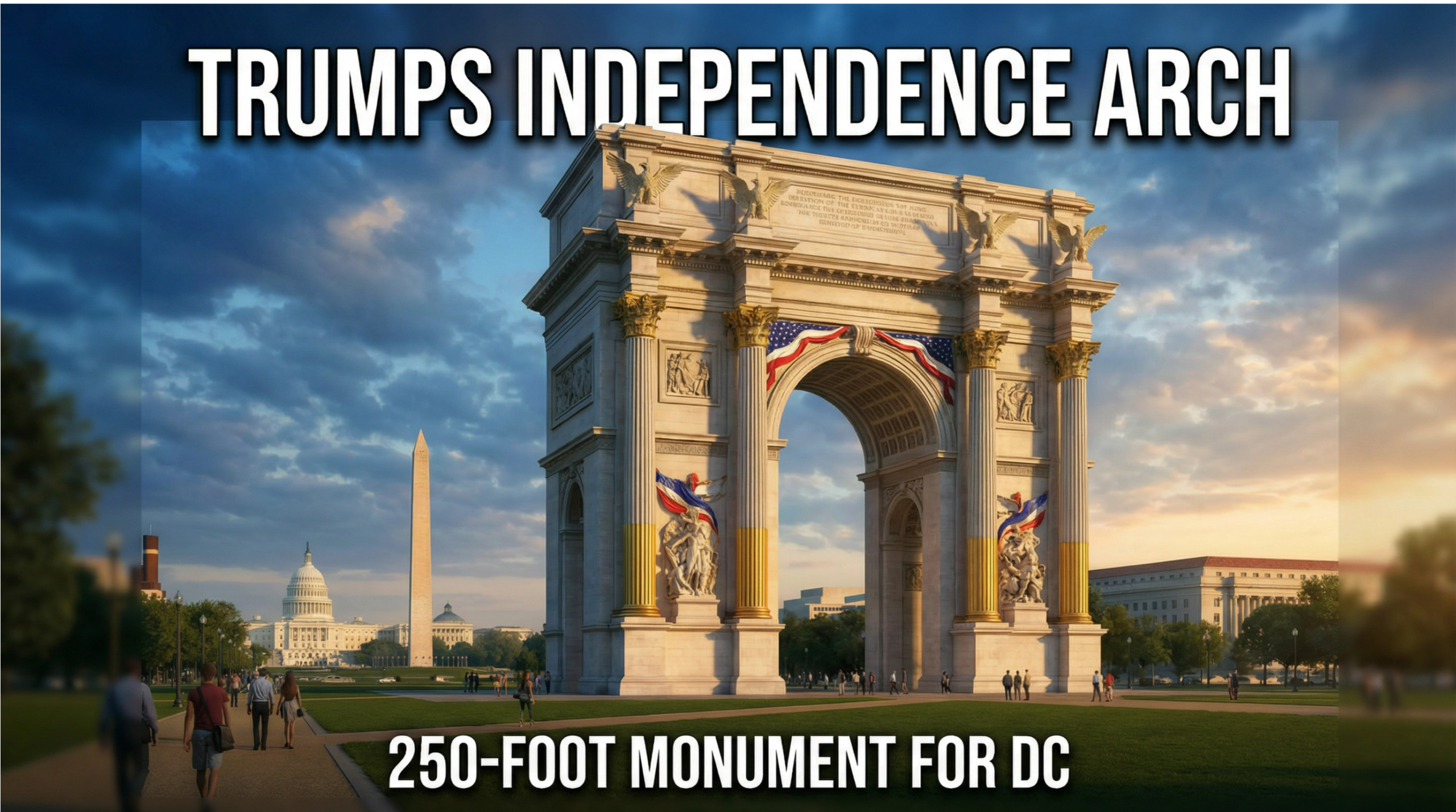
Arc de Trump
In an announcement that has ignited both fascination and controversy, President Donald J. Trump has unveiled plans for a massive new architectural landmark in Washington, D.C. The proposed structure — informally dubbed the “Independence Arch” or by critics as the “Arc de Trump” — would stand approximately 250 feet tall, dwarfing nearby monuments and signaling a bold new chapter in the capital’s visual identity.
Trump’s proposal comes as the United States approaches a major milestone: the 250th anniversary of its founding in 1776. The administration frames the project as a celebratory construction intended to honor two and a half centuries of American independence. But the implications of erecting such a colossal feature in one of the most symbolically loaded corridors of the nation’s capital have prompted widespread debate among historians, architects, preservationists, and the public at large.
A Monument to Mark a Semiquincentennial
President Trump first alluded to the idea of a triumphal arch several months ago, reviving an older concept that had periodically surfaced in discussions about Washington’s urban landscape. The basic inspiration for the structure comes from famous European triumphal arches like the Arc de Triomphe in Paris — a monument historically tied to national pride and military victory.
At events and in social media posts, Trump has emphasized that the United States, now a global superpower, deserves a landmark that reflects its stature. “For 200 years,” he said in a recent statement, “they wanted to build an arch… We’re the biggest, most powerful nation. I’d like it to be the biggest one of all.”
The president’s administration reportedly plans to begin preliminary work on the project before July 4, 2026, coinciding with planned celebrations of the country’s Semiquincentennial. During fundraisers and dinners with donors, three-dimensional models of the arch have been displayed, indicating design variations, including ornate elements like a statue of Lady Liberty atop the structure.
A Contested Location
The proposed site for the arch is a traffic circle on Memorial Drive known as Memorial Circle, situated between Arlington National Cemetery and the Lincoln Memorial, just across the Potomac River from the National Mall.
This location — deeply intertwined with longstanding national symbolism — has drawn particular scrutiny. The Lincoln Memorial, dedicated in 1922, is one of the most revered monuments in the capital, commemorating Abraham Lincoln’s leadership during the Civil War and his role in ending slavery. Its placement on the western edge of the Mall commands sweeping views along the reflecting pool and Capitol grounds, making it a focal point for visitors and national ceremonies.
Adding a towering arch nearby would dramatically alter that sightline and could shift how Americans experience the memorial landscape.
Praise, Skepticism, and Concern

Reactions to the arch proposal are sharply divided.
Supporters describe the project as a bold expression of national identity and a fitting tribute to America’s 250th birthday. Backers argue that Washington, D.C. is one of the few major capitals without a triumphal arch — an architectural form seen in capitals across Europe, Asia, and Latin America — and that such a monument would enhance the city’s appeal and reflect its global significance.
In contrast, critics raise concerns about the size, visual dominance, and historical impact of the structure. Architectural experts and preservationists have noted that a 250-foot arch — significantly taller than the 100-foot Lincoln Memorial — could overpower existing memorials and disrupt the carefully curated symmetry of the National Mall and its surroundings.
The proposed height would also raise questions about compliance with longstanding Washington building regulations, including the 1910 Height of Buildings Act, which historically limits the height of structures in the city. Some observers have speculated that Trump’s plans might prompt efforts to amend or reinterpret those rules.
Political and Cultural Undertones
Beyond architectural debate, the Independence Arch carries undeniable political resonance. For supporters of the president, the project represents a tangible legacy — a physical testament to Trump’s vision for America. Critics, however, view the monument as a self-aggrandizing symbol that could eclipse the memories invoked by older sites like the Lincoln Memorial.
This controversy mirrors broader discussions about how history is represented in American public spaces. In recent years, debates over statues, street names, and memorials have intensified, touching on issues of inclusion, heritage, and national narrative. The arch proposal has tapped into these themes, prompting deeper reflection on what collective identities and values should be enshrined in the nation’s capital.
Next Steps and Legal Hurdles
Despite the high-profile announcements and public statements, the project remains in the early stages. Federal land in Washington, especially near historic monuments, falls under the jurisdiction of agencies like the National Park Service and is subject to review by independent bodies such as the Commission of Fine Arts. These entities assess the aesthetic, historical, and environmental impacts of proposed developments.
Any attempt to move forward with the arch will likely involve regulatory hurdles, public comments, and potential legal challenges. Opponents have already signaled intentions to push back, citing concerns about preservation and the integrity of the National Mall’s historic layout.
At the same time, supporters may continue to lobby for expedited approvals, particularly as the 2026 anniversary draws closer.
A Monument in the Balance
Whether the Independence Arch eventually rises above the Potomac remains uncertain. What is clear, however, is that the conversation surrounding it has illuminated deep questions about how Americans commemorate their history, the role of national symbolism, and the evolving identity of the nation’s most treasured public spaces.
As 2026 approaches, the debate over the arch will likely continue — not just in Washington, but across the country, as citizens consider what monuments should mean and who gets to decide how history is enshrined in stone.